Why Bodily Autonomy Arguments for Abortion Matter to Pro-Choice and Pro-Life Women
Modern pro-choice arguments tend to focus on the question of fetal personhood rather than female bodily autonomy, but the latter still matters - surprisingly, especially for pro-life women.

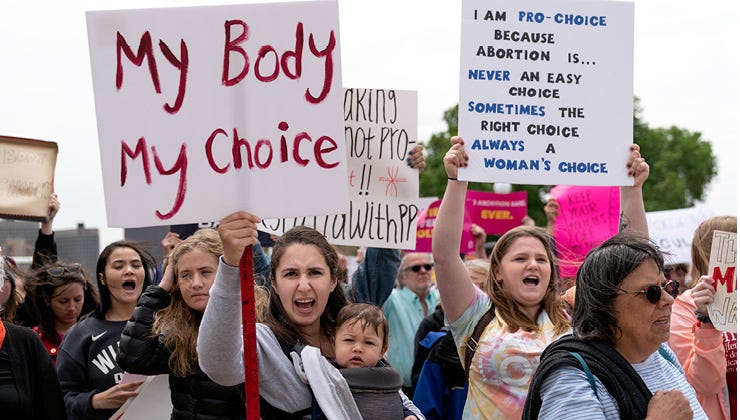
As a feminist who has spent hours debating abortion and writing pro-choice arguments, I’ve noticed a distinct shift in how debates around abortion are conducted. When abortion was primarily understood as a politically charged women’s rights issue, pro-choice advocates tended to frame the issue as one that related to female bodily autonomy - the right of a woman to refuse the use of her body to anyone (or anything) who required its use, even if that refusal resulted in their death.
Yet as pro-choice advocates have become more exposed to philosophical arguments relating to personhood, that dynamic has shifted. Now, instead of relying primarily on arguments related to bodily autonomy, pro-choice advocates have begun to increasingly focus on arguments related to fetal personhood.
Instead of blindly accepting the pro-life premise that “conception” granted the zygote the same moral status as the pregnant woman in the equation, pro-choice advocates reject the idea, pointing out that personhood does not hinge on a particular cell’s DNA composition or organism type but on mental features which an embryo or early fetus unambiguously lacks. Abortion rights, then, can be justified not by reference to female bodily autonomy but by reference to the idea there is nothing intrinsically problematic or immoral about (at least early) abortion in the first place; abortion then doesn’t harm a person.
This shift is a good thing. For one thing, these sorts of pro-choice personhood-based arguments are widely accepted in philosophical spaces, which speaks to their overall strength. For another, it’s always unwise in any sort of adversarial discourse to grant a false premise simply “for the sake of argument.” There was never any need to grant the flimsy pro-life premise that a zygote is equal in moral significance to the pregnant woman, so autonomy arguments, which work by granting the premise without argument, appear superfluous.
This shift, however, has had the unfortunate consequence of causing some disputants to seemingly forget that autonomy arguments exist at all. Often, the abortion debate is framed as purely about fetal personhood, as if all pro-life restrictions on abortion would become justified at some point in the pregnancy once the fetus acquired the minimal sorts of mental features necessary to be considered persons. For example, it’s fairly common for this sort of pro-choice debater, who rejects the idea that conception grants personhood, to nevertheless say that abortion should be restricted or banned after the first trimester, or 15 weeks, or some similar point. This point is usually based on beliefs that the fetus becomes conscious around that point.
Of course, a pro-choice feminist might reasonably ask: what about the woman who wants to get an abortion at 16 weeks? Autonomy arguments would justify this, even if the fetus is considered to be a person at 15 weeks. To justify banning or restricting abortion at 15 weeks, both the pro-life and the “moderate” pro-choice debater above must grapple with the classic autonomy argument for abortion, which argues abortion is permissible at least until viability (a moving target usually thought to be at at least 20 weeks.) Yet in the focus on personhood, the autonomy argument can sometimes seemingly be forgotten.
Both the pro-life and “moderate” pro-choice debater who favors legal restriction on abortion when the fetus is sufficiently developed (but before viability), then, can be said to endorse the following principle:
(A): A woman’s bodily autonomy may rightfully be legally restricted if doing so prevents sufficiently great harm to another person.
The pro-life/pro-fetal personhood side believes every fetus meets the “person” bar; the pro-personhood/anti-autonomy side believes that some early fetuses do not qualify as persons and therefore abortion may be permitted until those fetuses do meet that bar. While the latter group shares with feminists the political goal of permitting at least some abortions, they still endorse the (problematic) principle above, often without any given justification. Yet, as I will show below, this principle allows for coerced abortions as much as it allows for restrictions on abortion.
Why This Matters to Pro-Life Women
It is apparent that the pro-life principle that conception endows the zygote with personhood is losing support. The widespread acceptance of IVF, Plan B, and early elective abortion, all show that Americans increasingly believe that embryos and early fetuses lack the moral status of persons.
That suggests Americans may be drifting towards a widespread acceptance of early abortion even if they haven’t considered or outright reject the traditional female bodily autonomy arguments for abortion rights. People simply don’t regard embryos and early fetuses as persons, regardless of how they feel about female bodily autonomy arguments for abortion rights.
Why might this lead to issues for pro-life women? Let’s say there is a consensus that early abortion is perfectly moral on the basis that an embryo is not a person. But also assume that people accept principle A) above, which has traditionally been the default assumption built into pro-life reasoning. That is, assume people believe a woman’s bodily autonomy may be overridden if doing so prevents sufficiently great harm to another person. (In the pro-life world, this great harm is traditionally conceived of as the act of abortion.) But there’s no reason to think abortion is the only great harm that could be brought about.
There are undeniably some tragic genetic conditions in a fetus that will, if a pregnancy is brought to term, inevitably cause newborns extreme suffering followed by death. Such conditions are increasingly detected early in pregnancy. We can safely say that bringing about the existence of such a newborn - whose only conscious experiences will be those of suffering and confusion - would be a great harm to that newborn. We should absolutely hope that women made aware of their conditions will choose an early abortion to prevent such a short and purely miserable life from coming about.
Imagine a pro-life woman finds herself diagnosed with such a terrible fetal genetic condition in her fetus. In a world where people accept the principle outlined above - that a woman’s bodily autonomy and right to control her pregnancy may be overridden if doing so prevents a great harm to another person - that pro-life woman may well be legally required to get an abortion. In other words, the state, using the exact principles supported by the pro-life movement, may use legal action to coerce the unwilling pro-life woman into having an abortion. After all, continuing such a doomed pregnancy would lead to nothing more than a brief existence of extreme suffering for the newborn. That undeniably seems to be an act of extreme harm to a person, one arguably much worse than abortion even from the perspective that holds the fetus is a person.
Indeed, I believe feminists should hope that a reasonable pro-life woman would abort if she found herself in such a scenario. But legally coercing an abortion - by, say, finding the pro-life woman in violation of a law if she continues the pregnancy - strikes me as deeply immoral, even if doing so would prevent the suffering to the newborn described above. While we may hope such a woman chooses abortion, the decision ultimately must be hers.
Pro-life activists may scoff that the scenario above seems too far-fetched to worry about. But it’s important to note that the pro-life principle above actually would permit coerced abortion as much as coerced pregnancy, and that simply dismissing the idea as pragmatically far-fetched does not negate that. And throughout history, coerced abortions have actually been fairly common, while the pro-life principle that a zygote is automatically a person is fairly new and seems to be losing popularity.
A world in which the pro-life premise that the fetus is a person is rejected, while the pro-life premise that a woman’s bodily autonomy may be overridden for some other good is accepted, is a world in which legally coercing abortion, rather than restricting it, becomes a distinct possibility. The increasing, widespread acceptance of IVF, stem cell research, and early abortion suggests that we are already approaching widespread popular acceptance of anti-personhood arguments for early fetuses. Ironically, the pro-life woman who wishes to continue a pregnancy at all costs may need to rely on the traditional feminist bodily autonomy arguments she originally derided to justify continuing her pregnancy.
The only way to fully secure a woman’s right to continue a wanted pregnancy (as well as to abort an unwanted pregnancy) is to offer strong reasoning that emphasizes a woman’s right to bodily autonomy, not merely arguments that focus on the moral status of the fetus. While the latter will likely secure (at least early) abortion rights for women, a fuller defense of women’s reproductive autonomy must take female bodily rights into account. This is as true for anti-abortion women as for feminists.
While I appreciate the point you're making here, I also think it makes several utilitarian assumptions that most Americans (and especially, most pro-life people) do not assume.
You summarize the pro life and moderate pro choice position as:
"(A): A woman’s bodily autonomy may rightfully be legally restricted if doing so prevents sufficiently great harm to another person."
But I don't think that's how many of them would phrase it. There's a reason they call themselves "pro-life," rather than "anti-harm" or "anti-suffering." Many people's moral intuitions have a strong deontological streak, such that the *act of killing* directly bothers them more than declining to prevent some avoidable suffering. Some may also have a bias towards non-interference with what is natural, such that a naturally conceived child dying of natural causes could be seen as nobody's fault (or even, as God's will) in a way that taking an abortion pill could not be.
Finally, parents have duties to provide for their children that go beyond their duties to any other person, and some of those duties may encroach upon bodily autonomy. If a mother were somehow stranded on an island with her newborn and infant formula were not available, she may be obligated to breastfeed it to prevent it from starving, even though this encroaches on her bodily autonomy. But she may not have similar obligations to someone else on the island who wasn't her child.
Given that these differences matter to many people, I think more people in both the pro-life and moderate pro-choice camps would probably phrase it this way:
B: "A woman’s bodily autonomy may rightfully be legally restricted in order to prevent her from killing her child (once the child has achieved personhood)."
This narrower framing would avoid the problem you describe of greenlighting forced abortions in the case of terrible birth defects.
That many people care about those factors doesn't mean they should actually matter, and I'm not convinced they all do. But it could limit how persuasive most pro life people find your argument that they should care about bodily autonomy, unless you also persuaded them of several other things.
Very good, as always! Some comments:
I like the observation that there was never any need to accept the assumption that fetuses are persons "for the sake of argument." I think it's almost like someone long ago asked, "What if we assume that rocks and plants are persons, for the sake of argument; how should we act?" and then everyone forgot that this was a mere assumption: they just started acting like this is a fact.
I would like some evidence though about these types of empirical claims, since they don't really fit my observations:
"pro-choice advocates have begun to increasingly focus on arguments related to fetal personhood."
"some disputants [now] seemingly forget that autonomy arguments exist at all."
And observing, or arguing, that autonomy has limits isn't "forgetting" that bodily autonomy arguments exist: it's perhaps just rejecting that they are the "slam dunk" that some seem to think they are. (Thompson didn't think that!).
About that there are "some tragic genetic conditions in a fetus that will, if a pregnancy is brought to term, inevitably cause newborns extreme suffering followed by death," I think you will need to explain why this is worse than being aborted, and how someone would know (or reasonably believe) that. Especially since another option is euthanasia upon birth. This is relevant too:
Gary Comstock, “You Should Not Have Let Your Baby Die,” The New York Times, July 12, 2017.
https://www.nytimes.com/2017/07/12/opinion/you-should-not-have-let-your-baby-die.html